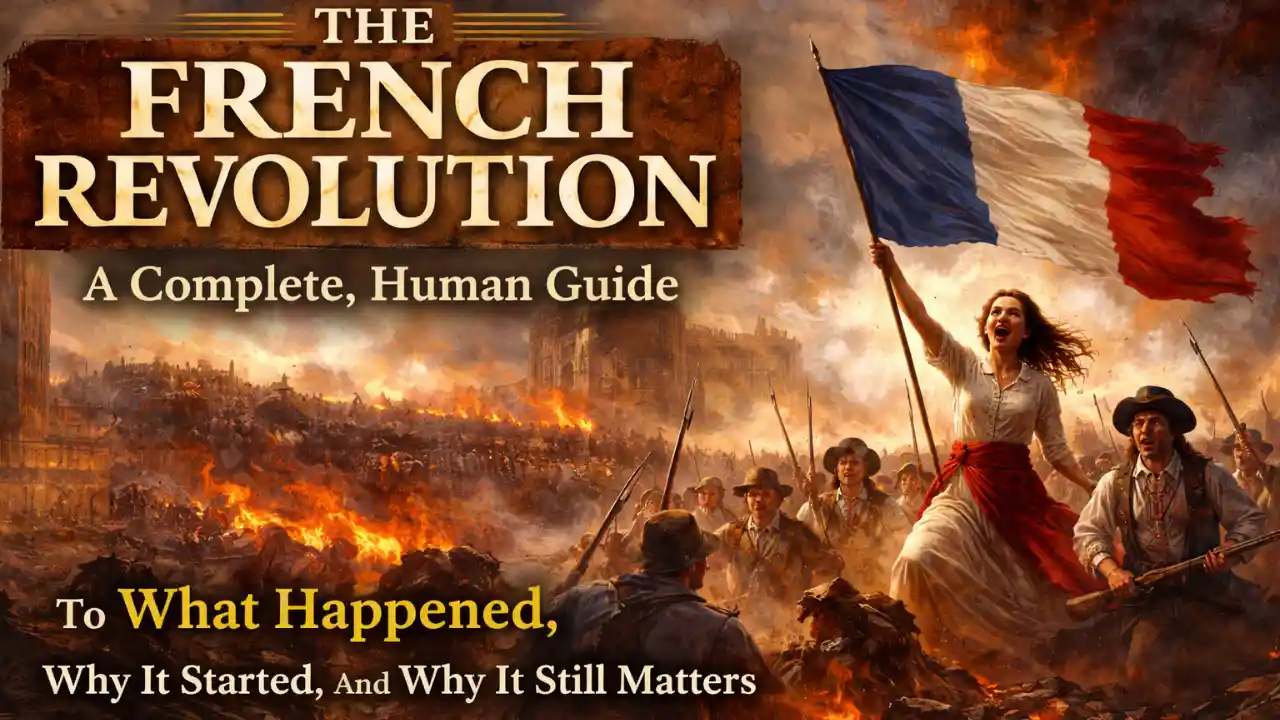
The French Revolution: A Complete, Human Guide To What Happened, Why It Started, And Why It Still Matters
The French Revolution did not begin with a dramatic speech or a single act of violence. It began quietly, in the daily frustration of people who felt trapped in a system that no longer made sense. Most families worked hard yet stayed poor. A small group lived comfortably and made the rules. Over time, that imbalance stopped feeling normal and started feeling unbearable. When people finally spoke up, they were not asking for chaos. They were asking for fairness, dignity, and a chance to live without fear of hunger or punishment for simply being born into the wrong class.
Now that you know the emotional weight behind the story, it helps to step back and look at what the French Revolution actually was before diving into the details.
What Was The French Revolution
The French Revolution was a period of deep political and social change in France where the old system of absolute monarchy and rigid class structure began to collapse. Before this time, France was ruled by a king who held most of the power, and society was divided into groups with very unequal rights. Ordinary people had little say in how the country was run, even though they made up the majority of the population and carried most of the tax burden.
The revolution did not follow a neat plan. It moved in waves. At first, people demanded reforms and fairer rules. When those demands were ignored or blocked, frustration turned into open resistance. Political meetings became more intense, public protests grew louder, and trust in the monarchy faded quickly. The old system could not survive once people stopped believing in it.
That brings us to the deeper question of what the French Revolution was truly about beyond the surface-level political changes.
What Was The French Revolution About
At its heart, the French Revolution was about dignity. People wanted to be treated as citizens, not as subjects who existed only to serve those above them. The movement pushed for basic ideas that sound normal today, like equal treatment under the law, freedom of expression, and limits on the power of leaders. These ideas were radical at the time because they challenged the belief that kings ruled by divine right.
The revolution was also about control over daily life. Many families struggled to afford food, while the ruling class lived comfortably. Laws favored nobles and clergy, even when they contributed little to the economy. Over time, the gap between the powerful and the powerless became impossible to ignore. The desire for a fairer system became stronger than fear of punishment.
Now that the purpose is clearer, it helps to understand where these events unfolded and why certain places became so important.
Where Did The French Revolution Take Place
The French Revolution took place across France, but Paris became the emotional center of the movement. Paris was crowded, politically active, and full of people who felt the pressure of rising food prices and limited work opportunities. When protests broke out in the capital, they quickly drew attention and inspired similar actions in other cities and rural areas.
News traveled fast through word of mouth, pamphlets, and public speeches. What began as political tension in meeting halls soon spilled into streets and marketplaces. The spread of unrest showed that dissatisfaction was not limited to one city. The problems were national, and so was the response.
To understand the timeline, it helps to anchor these events in specific years.
What Year Was The French Revolution
Many people associate the French Revolution with the year 1789, and that is fair. That year marked the visible beginning of large-scale change. Public anger turned into organized political action, and long-standing institutions started to break apart.
Still, 1789 was not the end of the story. It was the opening chapter. The years that followed were filled with experiments in government, internal conflicts, and rapid changes in leadership. Each phase of the revolution built on the chaos and hopes of the previous one.
That brings us to the broader timeline of when the French Revolution took place.
When Was The French Revolution
The French Revolution stretched across several years, roughly from 1789 to the late 1790s. During this time, France moved through different political systems, including attempts at constitutional monarchy and republican government. The constant changes reflected how unstable the situation was. No single group had full control for long, and fear of betrayal or counter-revolution shaped many decisions.
As the revolution continued, its goals shifted. Early calls for reform turned into demands for radical change. What began as a push for fairness evolved into a struggle over who would define the future of the country.
Now that the broader timeframe is clear, it helps to look at the exact moment when everything truly began to unravel.
When Did The French Revolution Start
The French Revolution began in a practical sense when the monarchy called a political assembly to deal with financial problems. The meeting exposed how unequal the system was, especially in how votes were counted and whose voices mattered. When representatives of the common people realized they were being sidelined, they refused to accept the rules of a system that no longer served them.
Public frustration spilled into the streets soon after. Protests became larger and more emotional, and symbols of royal authority were challenged openly. Once people realized that collective action could force change, there was no easy way to return to the old order.
Now that the starting point is clear, that brings us to the deeper causes that pushed society to the edge in the first place.
What Caused The French Revolution
The French Revolution did not come from a single mistake by the monarchy. It was the result of years of pressure building up in everyday life. Many families struggled to survive while watching a small group live comfortably without carrying the same burdens. Taxes fell heavily on those who could least afford them, and unfair laws protected those who already had power.
Economic hardship made people more sensitive to injustice. When basic needs like food became harder to meet, patience disappeared. Political ideas from outside France also played a role, showing people that other systems were possible. Over time, frustration turned into a belief that the entire structure of society needed to change.
That brings us to one of the most powerful everyday pressures people felt at the time.
How Did Bread Prices Fuel Public Anger
Bread was not just food. It was survival. When the price of bread rose, families had to choose between eating and paying for other necessities. Many workers spent most of their income on basic food, so even small price increases felt devastating.
As bread became more expensive, anger grew quickly. People did not see this as a natural problem. They saw it as a failure of leadership. When leaders seemed more concerned with court life than with hunger in the streets, resentment deepened. The struggle to feed one’s family became a political issue, not just a personal one.
That daily struggle connects closely to another source of anger that shaped public opinion.
Why Was Taxation A Major Grievance Before The Revolution
Taxes were not shared fairly. Ordinary people paid heavy taxes, while many nobles and clergy were protected by special privileges. This imbalance made everyday life harder for those who already had little. People felt trapped in a system where they carried the weight but had no voice in how money was used.
Over time, taxation became a symbol of everything that felt wrong. It was not just about money. It was about respect. Paying into a system that ignored your needs created resentment that went far beyond numbers on a page.
This imbalance was part of a much larger social structure that shaped how people saw their place in society.
How Did Class Structure Change After Feudalism Was Abolished
Before the revolution, French society was built on a rigid hierarchy. Your birth largely decided your future. Nobles and clergy enjoyed privileges that ordinary people could never access, while farmers, workers, and small merchants carried most of the burdens. This system, often called feudal, made social movement almost impossible. Even hard work rarely changed a person’s position.
When feudal privileges were abolished, it did not instantly make everyone equal, but it broke the idea that some people were naturally superior by law. Land ownership rules changed, legal protections became more uniform, and old titles lost much of their power. For many people, this was the first time the idea of being a citizen rather than a subject felt real. That shift in thinking mattered just as much as any law that was passed.
Now that you can see how daily life and social structure created pressure, it makes sense to look at the ideas that helped people imagine a different kind of society.
How Did The Enlightenment Influence The French Revolution
The Enlightenment was a period when writers and thinkers began questioning old beliefs about power, religion, and authority. Instead of accepting that kings ruled because they were chosen by God, these thinkers argued that power should come from the people and that laws should be based on reason. These ideas did not stay in books. They spread through salons, pamphlets, and conversations in cafés.
For many readers, these ideas felt like a wake-up call. They gave words to frustrations people already felt. When someone read that all people should be equal before the law, it became harder to accept a system that clearly was not. The Enlightenment did not cause hunger or poverty, but it helped people understand that these problems were not unavoidable. They were the result of choices made by those in power.
Alongside these new ideas, another recent event showed that challenging a powerful ruler was not only possible but successful.
How Did The American Revolution Influence The French Revolution
The American Revolution proved that a group of colonies could stand up to a powerful monarchy and win. French soldiers and officers who had taken part in that conflict returned home with stories of a new kind of political system, one based on representation and written rights. These stories spread quickly and captured the imagination of many people in France.
More importantly, the American example made change feel realistic. It was no longer just a theory discussed by philosophers. It was something that had already happened. When people in France looked at their own situation, they began to ask why they should accept less freedom than others had already claimed for themselves.
Now that the causes and influences are clearer, that brings us to what actually happened once the pressure finally exploded.
What Happened During The French Revolution
The French Revolution unfolded in stages, each more intense than the last. At first, people hoped for reform. They wanted fairer taxes, a voice in government, and limits on royal power. When those hopes were blocked or delayed, protests grew stronger. Political debates moved from meeting rooms into the streets, and symbols of the old order became targets of public anger.
As time went on, fear and suspicion began to shape decisions. Different groups argued about how far the changes should go. Some wanted a constitutional monarchy. Others wanted to remove the king entirely. This tension led to power struggles, sudden shifts in leadership, and moments of extreme violence. The revolution was not a straight line forward. It was a series of sharp turns, driven by both hope and fear.
One of the first places where this conflict became impossible to ignore was in a political assembly that was supposed to fix France’s problems.
What Role Did The Estates-General Play In The French Revolution
The Estates-General was a political body that represented different social groups in France. It was called together to deal with the country’s financial crisis, but it quickly became clear that the system was unfair. Each group had one vote, even though the common people represented far more of the population. This meant that the groups with privileges could block any real change.
When representatives of the common people realized this, they refused to accept the old rules. They declared themselves a new national assembly, claiming the right to speak for the nation. This was a turning point. It showed that authority no longer belonged only to the king. It could be claimed by the people themselves.
That political break soon turned into a powerful public moment that is still remembered today.
Why Was The Storming Of The Bastille Important
The Bastille was a fortress and prison that symbolized royal power and control. When crowds in Paris attacked it, they were not just looking for weapons or prisoners. They were making a statement. They were showing that the symbols of fear and authority could be challenged and taken down.
The fall of the Bastille sent a shock through France. It proved that the old system was no longer untouchable. For many people, it was the moment the revolution became real. From that point on, events moved faster, and the possibility of returning to the old order faded quickly.
As pressure continued to build, the very foundation of royal power began to crack.
How Did The Monarchy Fall During The Revolution
At first, the king remained in place, but his power was limited by new laws and assemblies. Over time, trust between the monarchy and the public disappeared. Attempts to flee, secret negotiations, and fear of foreign intervention made many people believe the king could not be trusted to protect the new system.
Eventually, the idea of keeping a king at all became unacceptable to the more radical groups. The monarchy was abolished, and France was declared a republic. This was a dramatic shift, not just in leadership, but in how people understood authority. Power was no longer tied to a crown. It was claimed in the name of the nation.
With the old leadership gone, the question of who should guide the revolution became more urgent than ever.
Who Led The French Revolution
The French Revolution did not have one single leader. Instead, power shifted between different figures and groups over time. Some leaders were skilled speakers, others were strong organizers, and some gained influence through fear and control. What they shared was the ability to shape public opinion during moments of crisis.
As the revolution became more radical, leadership also became more dangerous. Political rivals accused each other of betrayal, and changes in power often came suddenly. This constant struggle made the revolution unstable, but it also showed how deeply people cared about the direction their country was taking.
One of the biggest sources of conflict came from disagreements inside the revolutionary movement itself.
How Did The Jacobins Differ From The Girondins
The Jacobins and the Girondins were two major political groups with different visions for the future of France. The Girondins generally favored a more moderate approach, with limits on how far the revolution should go. They worried that too much violence and radical change would destroy the country.
The Jacobins, on the other hand, believed strong measures were necessary to protect the revolution from its enemies, both inside and outside France. They were more willing to use force and strict laws to achieve their goals. As tensions grew, these differences turned into open conflict, and the more radical position eventually took control.
That shift in power led to the creation of a body that would come to define one of the darkest periods of the revolution.
What Was The Committee Of Public Safety
The Committee of Public Safety was created to protect the revolution during a time of war and internal unrest. It was given broad powers to make quick decisions, enforce laws, and deal with anyone seen as a threat. In theory, it was meant to save the country. In practice, it became a tool for extreme control.
Under its authority, arrests and executions increased sharply. Fear became a part of daily life, even for those who supported the revolution. The idea of protecting freedom began to clash with the reality of how that protection was enforced.
This period of intense control and violence became known by a name that still carries weight today.
What Was The Reign Of Terror
The Reign of Terror was a time when the revolutionary government used fear as a political weapon. Thousands of people were arrested and executed on suspicion of being enemies of the revolution. Trials were often quick, and evidence was sometimes weak or based on rumors.
The goal was to eliminate threats, but the result was a climate of constant suspicion. Neighbors feared neighbors. Former allies turned on each other. The revolution, which began with hopes of freedom and fairness, had reached a point where survival often depended on staying invisible.
One symbol, more than any other, came to represent this terrifying phase.
How Did The Guillotine Become A Symbol Of The Revolution
The guillotine was introduced as a more humane way to carry out executions, but it quickly became a symbol of fear and power. Public executions were meant to show that the law was in control, but they also reminded everyone how quickly someone could fall from favor.
As more and more people were executed, the guillotine came to represent the dark side of the revolution. It showed how a movement that began with ideals could turn into something harsh and unforgiving when driven by fear and desperation.
Two of the most famous victims of this period were figures who once stood at the center of French power.
What Happened To King Louis Xvi
King Louis XVI was put on trial after the monarchy was abolished. Many people saw him as a symbol of the old system and a threat to the new republic. His execution marked a point of no return. There was no longer any possibility of restoring the old monarchy without starting another war.
For supporters of the revolution, his death was proof that no one was above the law. For others, it was a shocking moment that showed how far the country had moved from its past. Either way, it changed the tone of the revolution forever.
Soon after, attention turned to another figure who had become a powerful symbol in the public imagination.
What Role Did Marie Antoinette Play In The Crisis
Marie Antoinette became a target of public anger long before she was arrested. She was seen as a symbol of excess and indifference to the suffering of ordinary people. Whether these images were fair or exaggerated, they shaped how the public viewed the monarchy as a whole.
Her trial and execution were as much about symbolism as about politics. For many, her fall represented the final break with the old royal world. It showed that the revolution was not just changing laws. It was ending an entire way of life.
As dramatic as these events were, they also came at a terrible human cost, which brings us to one of the hardest questions to face.
How Many People Died In The French Revolution
The exact number is hard to calculate, but it is clear that tens of thousands of people lost their lives during the French Revolution. Some were executed during the Reign of Terror. Others died in wars, uprisings, or from the chaos that followed the breakdown of normal life. Behind every number was a family, a story, and a life cut short.
This loss of life reminds us that revolutions are not just about ideas. They are also about real human suffering. Even when people believe they are fighting for a better future, the cost can be incredibly high.
A large part of that cost came from conflicts beyond France’s borders, as other countries reacted to what was happening.
Why Did Foreign Powers Go To War With Revolutionary France
Many European rulers feared that revolutionary ideas would spread to their own countries. A successful republic built on the downfall of a king was a dangerous example for monarchies everywhere. To them, stopping France was not just about territory. It was about survival.
As a result, several countries formed alliances to fight revolutionary France. These wars increased pressure at home and made leaders even more suspicious of internal enemies. The fear of invasion made the government more willing to use extreme measures in the name of security.
One of the first major conflicts in this wider struggle had a specific name.
What Was The War Of The First Coalition
The War of the First Coalition was a conflict between revolutionary France and a group of European powers who wanted to stop the spread of revolutionary ideas. Fighting on multiple fronts drained resources and heightened fear inside France.
This external threat made the situation at home even more unstable. Leaders argued that strong control was necessary to keep the country from falling apart. War and politics became tightly linked, and decisions made in Paris were influenced by what was happening on distant battlefields.
Not all conflicts, however, came from outside France. Some of the most painful fighting happened within the country itself.
What Was The Vendee Uprising
The Vendée Uprising was a rebellion in a rural region where many people opposed the revolutionary government, especially its treatment of the church and its new laws. This was not just a political disagreement. It became a brutal civil conflict, with violence on both sides.
The uprising showed that the revolution did not have the same meaning for everyone. While some saw it as a path to freedom, others saw it as an attack on their traditions and beliefs. The way the government responded to this rebellion added to the cycle of fear and retaliation.
In times like these, controlling public opinion becomes almost as important as controlling armies.
What Role Did Propaganda Play During The Revolution
Propaganda played a huge role in shaping how people understood events. Newspapers, pamphlets, and speeches were used to inspire support, spread fear, and attack political enemies. Words became weapons, and stories were often simplified to create heroes and villains.
This constant flow of information and misinformation made it hard for people to know who to trust. It also made emotions run higher, which pushed the revolution toward more extreme positions. Public opinion was not just observed. It was actively shaped.
These ideas did not stay inside France. They traveled far beyond its borders.
How Did Revolutionary Ideas Spread Across Europe
Soldiers, travelers, and writers carried revolutionary ideas with them wherever they went. When people in other countries heard about citizens overthrowing a king and rewriting their laws, it forced them to question their own systems.
Some governments tried to block these ideas. Others tried to adapt them. Either way, the French Revolution became more than a national event. It became a turning point in how people across Europe thought about power, rights, and authority.
Now that you’ve seen the violence and conflict, it’s time to look at how the revolution also changed everyday life and society in deeper ways.
How Did The Revolution Change Society
Now that you’ve seen the chaos, violence, and power struggles, it’s easy to think the French Revolution was only about bloodshed and politics. That’s a shallow take. The deeper impact was how it reshaped daily life, identity, and what people expected from the state. For the first time, many ordinary people began to see themselves as citizens with rights, not just subjects who obeyed orders. That mental shift outlived every leader of the revolution.
The changes did not arrive neatly. Some reforms helped people quickly. Others created new problems. But the direction was clear. The old social order, built on birth and privilege, was being replaced by a system that at least claimed to value equality under the law.
Who Were The Sans-Culottes
The sans-culottes were working-class Parisians who became one of the most visible forces of the revolution. The name came from their simple clothing, which set them apart from the wealthy elite. They were shop workers, laborers, and small tradespeople who felt the pressure of food shortages and rising prices every day.
Their importance came from numbers and presence. When they protested, leaders paid attention. When they supported a political group, that group gained power. They pushed the revolution in a more radical direction because their daily reality left little room for patience. For them, political change was not theory. It was about survival.
What Role Did Women Play In The French Revolution
Women were everywhere in the revolution, even if history often pushes them to the background. They organized marches, demanded fair bread prices, and took part in political debates. Many women believed that if society was being rebuilt, they deserved a voice in that process.
Their participation challenged traditional roles. Some women ran political clubs, wrote pamphlets, and spoke in public spaces that were previously closed to them. Even when their demands were later pushed aside, their involvement showed that the idea of citizenship had begun to expand beyond old limits.
What Did The Tricolor Flag Represent
The tricolor flag became a powerful symbol of the new France. Its colors represented unity between the people and the city of Paris, with the monarchy’s color woven into the design to signal a break from absolute rule. Over time, the flag came to stand for shared identity rather than loyalty to a king.
Symbols matter because they give people something to rally around. The flag turned political ideas into something visible and emotional. It allowed people to feel part of something larger than themselves, especially during moments of fear and uncertainty.
Why Did The National Anthem Gain Power During The Revolution
The national anthem became popular because it spoke to emotion, not just logic. Music helped people feel connected to the revolution, even if they did not fully understand every political argument. Singing together created a sense of unity that laws alone could not create.
In times of crisis, shared rituals matter. The anthem gave people a way to express loyalty to the new nation rather than to a single ruler. It helped turn abstract ideas about freedom and sacrifice into something people could feel in their bodies.
Why Did The Revolution Create A New Calendar
The revolutionary government introduced a new calendar to symbolically break from the old order. They wanted to mark time in a way that reflected new values rather than religious traditions tied to the monarchy. Even the names of months were changed to reflect nature and seasonal work.
This change might seem small, but it shows how deeply the revolution tried to reshape society. The goal was not just new laws. It was a new way of thinking about everyday life. Time itself was being reimagined as part of a fresh start.
How Did The Metric System Spread During The Revolution
The metric system was promoted as a rational, fair way to measure the world. Old measurement systems varied by region, which made trade confusing and unfair. Standardizing measurements was part of a larger effort to bring order to daily life and remove privileges tied to local customs.
This reform lasted far beyond the revolution. It shows that not every change was temporary or chaotic. Some ideas introduced during this period became permanent improvements that shaped modern life.
How Did The Revolution Change The Relationship With The Church
The revolution challenged the church’s traditional power. Church lands were taken over by the state, and religious authority was brought under government control. For many supporters of the revolution, this was about ending privilege and bringing religion into the same legal framework as other institutions.
For others, this felt like an attack on deeply held beliefs. The tension between revolutionary ideals and religious tradition created conflict, especially in rural areas where faith played a central role in community life.
What Was The Civil Constitution Of The Clergy
The Civil Constitution of the Clergy was a law that reorganized the church under state authority. Clergy were required to swear loyalty to the new government, which divided religious communities. Some accepted the new system. Others refused and were treated as enemies of the state.
This law deepened divisions within France. It showed how reforms meant to create unity could also create new lines of conflict. The revolution was not only changing politics. It was reshaping beliefs and identities, often in painful ways.
Now that you’ve seen how daily life and social structures changed, that brings us to the hard question people still argue about today: did all of this actually work?
Was The French Revolution Successful
Whether the French Revolution was successful depends on what you measure. If you look only at stability, the answer feels complicated. The period was filled with chaos, violence, and constant political change. Many people suffered, and the country did not become peaceful overnight.
If you look at long-term change, the picture shifts. The revolution permanently weakened absolute monarchy, promoted the idea of legal equality, and reshaped how people understood citizenship. Even when later governments tried to limit these ideas, they could not erase them. The revolution changed what people believed was possible.
That brings us to the broader consequences that continued long after the fighting stopped.
What Were The Effects Of The French Revolution
The effects of the French Revolution went far beyond France. Inside the country, old privileges were dismantled, and new legal frameworks began to shape daily life. Outside France, rulers and citizens alike watched closely, learning from both the successes and failures of the revolutionary experiment.
The revolution also changed how political change was imagined. It showed that ordinary people could reshape their government, even if the process was messy and painful. That idea alone had ripple effects across continents.
Some of the most concrete effects came from specific legal and social reforms.
What Laws Ended Feudal Privileges
Feudal privileges were abolished through laws that removed special rights tied to birth. Nobles no longer had automatic legal advantages, and many old obligations placed on peasants were removed. This shift did not erase inequality overnight, but it broke the legal foundation that supported it.
By removing these privileges, the revolution changed how people related to authority. Law became something that, at least in theory, applied to everyone. This was a radical change from a system where your birth decided your legal standing.
How Did Property Rights Change During The Revolution
Property ownership became more accessible as church lands and noble estates were redistributed or sold. This created new opportunities for some families to own land for the first time.
At the same time, these changes also created winners and losers. Those who could afford to buy land gained power, while others felt left behind. The revolution reshaped property rights, but it did not magically create equal wealth.
How Did The Revolution Affect Nobility Status
The nobility lost many of their legal privileges and social authority. Titles alone no longer guaranteed power or protection. Some nobles fled the country. Others tried to adapt to the new system.
This loss of status changed how society viewed inherited power. Respect was no longer supposed to come from birth alone. Even when old habits lingered, the idea that everyone should be equal before the law had taken root.
What Reforms Changed The Legal System
The legal system was restructured to be more uniform and accessible. Laws were standardized, and legal rights were meant to apply equally to all citizens. While practice did not always match theory, the intention marked a major shift away from fragmented, privilege-based justice.
These reforms laid the groundwork for modern legal systems that emphasize consistency and written codes. The revolution pushed law out of private privilege and into the public sphere.
How Did The Revolution Change Education In France
Education became a tool for shaping citizens rather than just serving elites. New approaches aimed to spread basic education more widely and promote values aligned with the new political order.
This focus on education reflected a belief that a free society required informed citizens. Even though resources were limited, the idea that education should serve the public good gained strength during this period.
How Did The Economy Change After The Revolution
The economy went through periods of instability, especially during war and political upheaval. Inflation, shortages, and uncertainty made daily life difficult for many families.
Over time, however, economic structures began to shift toward systems based more on contracts and markets rather than inherited privilege. The transition was painful, but it marked a move away from the old economic order.
How Many Constitutions Did France Adopt During The Revolution
France adopted several constitutions during and shortly after the revolution as leaders experimented with different forms of government. Each new constitution reflected changing ideas about power, representation, and authority.
This constant rewriting shows how uncertain the path forward was. The revolution was not guided by a single blueprint. It was shaped by trial, error, and intense political struggle.
How Did Napoleon Rise After The Revolution
The instability of the revolutionary period created a power vacuum. Military success and promises of order allowed Napoleon to rise as a strong leader. Many people, exhausted by chaos, welcomed stability even if it meant less political freedom.
Napoleon’s rise shows one of the paradoxes of the revolution. A movement that began by challenging absolute power eventually led to a new form of centralized authority. Even so, the changes brought by the revolution continued to shape France under his rule.
Now that the national impact is clear, it’s time to step back and look at how these events reshaped the world beyond France.
How Did The French Revolution Affect The World
Now that you know how deeply the revolution reshaped France, it’s important to see that the impact did not stop at its borders. The French Revolution sent shockwaves across continents. It changed how people everywhere thought about power, rights, and who should be allowed to rule. Even countries that tried to block revolutionary ideas could not completely stop them from spreading.
The message was simple but dangerous to old systems: if people in one country could challenge a king and rewrite their laws, others could too. That idea alone was enough to unsettle rulers across Europe and beyond.
When Was Slavery Abolished In French Colonies During The Revolution
One of the most dramatic global effects of the revolution was the temporary abolition of slavery in French colonies. Revolutionary ideals of liberty and equality clashed directly with the reality of forced labor in overseas territories. Under pressure from uprisings and changing political values, slavery was abolished for a time.
This decision was not stable. Later political shifts reversed some of these changes. Still, the moment mattered because it showed that revolutionary ideas had the power to challenge even deeply entrenched systems of exploitation. It also proved that the revolution’s promises of freedom reached far beyond Europe, even if imperfectly.
How Did The Revolution Influence Haiti
The French Revolution had a powerful influence on the uprising in what would become Haiti. Enslaved and free people of color drew inspiration from revolutionary ideas about rights and equality. They used the language of liberty to demand their own freedom and dignity.
The result was one of the most significant slave revolts in history, which eventually led to the creation of an independent nation. This outcome terrified slave-owning societies elsewhere and reshaped global politics. It showed that the revolution’s ideas could empower people who had been denied humanity for generations.
How Does The French Revolution Compare To Other Revolutions
When compared to other revolutions, the French Revolution stands out for how radical and far-reaching it was. Some revolutions focus mainly on changing leadership. The French Revolution aimed to remake society itself. It challenged class structures, religious authority, and long-standing traditions all at once.
At the same time, it shared patterns with other revolutions. Economic hardship, unfair systems, and the spread of new ideas often create similar pressures in different countries. The French Revolution became a reference point, a case study that later movements studied, copied, and tried to avoid repeating in its most violent phases.
What Changed For Peasants After The Revolution
For peasants, the end of feudal privileges brought real changes. Obligations tied to old systems were removed, and legal barriers based on birth were weakened. Many people gained more control over their work and land than they had before.
That said, life did not become easy overnight. Economic instability and war created new hardships. The revolution opened doors, but it did not guarantee comfort. The most important change was psychological. Peasants began to see themselves as citizens with rights, not just laborers bound by tradition.
What Long-Term Political Reforms Came From The Revolution
The revolution helped establish ideas that still shape modern politics, such as written constitutions, legal equality, and the concept of citizenship. Even when later governments tried to limit these principles, they could not fully erase them.
These reforms influenced how states were built in the years that followed. The idea that governments should be accountable to the people became part of political debate across Europe and beyond. The revolution planted seeds that continued to grow long after the violence ended.
What Lessons Can Be Learned From The French Revolution
One of the clearest lessons is that ignoring deep social and economic problems eventually leads to crisis. The French monarchy did not collapse overnight. It collapsed because leaders failed to respond to growing pressure until people felt they had nothing left to lose.
Another lesson is that good intentions do not guarantee good outcomes. The revolution began with ideals of freedom and equality, but fear and power struggles led to extreme violence. This shows how easily movements for change can lose their way when driven by desperation and distrust.
How Did The Revolution Influence Modern Citizenship
Modern ideas of citizenship owe a great deal to the French Revolution. The belief that people are citizens with rights, rather than subjects who owe blind loyalty to a ruler, became central to modern political identity.
Citizenship came to mean participation, legal protection, and a voice in public life. Even though these ideals were not perfectly realized during the revolution, they reshaped expectations for future generations. People began to believe that belonging to a nation came with rights as well as responsibilities.
Now that you’ve seen the global impact and lasting lessons, everything circles back to one final truth. The French Revolution was not just a historical event. It was a turning point in how people understood power, justice, and themselves. The world after the revolution could never fully return to what it was before, because once people see that change is possible, they can’t unsee it.
Final Thoughts On Why The French Revolution Still Matters
Now that you know the full story, it’s easier to see the French Revolution as more than a dramatic chapter in history books. It was a moment when ordinary people challenged a system that had treated inequality as normal for generations. The change did not come cleanly. It came with mistakes, fear, and violence. But it also came with ideas that reshaped how people think about rights, power, and responsibility.
That brings us to the uncomfortable truth many prefer to avoid. Big change is rarely gentle. When pressure builds for too long, it tends to explode rather than fade away quietly. The French Revolution is a warning and a lesson at the same time. It shows what happens when leaders ignore real problems, and it shows how powerful ordinary people can become when they believe change is possible.
In short, the revolution did not just transform France. It rewired how the modern world thinks about citizenship, law, and political voice. That influence is still visible today, in how nations write their constitutions, define rights, and debate who power should truly belong to.